Selling wine online is getting more competitive. Importers, retailers, wineries, and specialist merchants strive to reach customers through search, social media, marketplaces, email, events, and their own websites.
That said, new customers don’t always have to come from paid ads or marketplace listings. For many wine businesses, a useful growth channel is already close at hand: happy customers willing to recommend your wines to someone else.
A referral program gives that behavior an easy outlet. It makes it easier for customers to share a good experience, and it gives new buyers a clear reason to place their first order. This matters in Japan, where ecommerce continues to grow and customer trust carries a lot of weight. According to METI, Japan’s domestic B2C ecommerce market reached 26.1 trillion yen in 2024, while the food, drinks, and liquor category reached 3.1163 trillion yen in B2C EC market scale. Nielsen’s trust research also found that 88% of global respondents trust recommendations from people they know more highly than any other channel.
Why referrals fit wine ecommerce
Drinking wine is typically a social experience, which lends itself well to recommendations. While many customers enjoy wine, they may not always feel confident choosing a bottle online. Region, grape, vintage, producer, sweetness, food pairing, and price can all affect their decision, and it’s this abundance of options that makes referrals feel natural in wine ecommerce settings. A customer who enjoys a mixed set, a gift box, or a memorable bottle often already has someone in mind who might like it too.
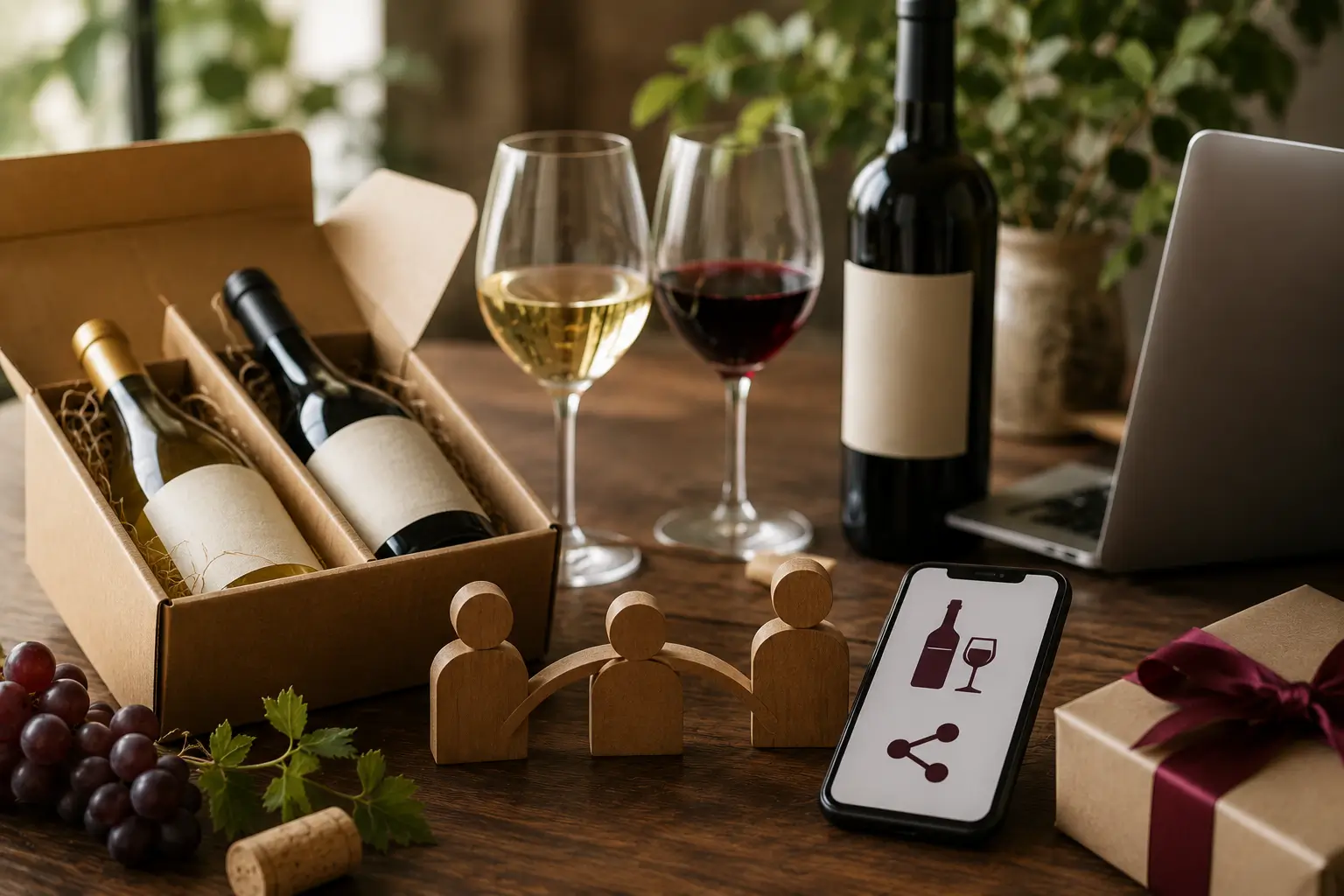
Bottles are opened at dinners, shared at gatherings, and sent as gifts. Japan’s seasonal gift culture, including ochugen and oseibo, creates additional moments when customers are already thinking about what to send and who to send it to. A good referral program should build around this custom of sharing, making it feel less like an “earn rewards” program and more like a “share a wine you enjoyed” experience.
Start with clear goals
The first step is to decide what the referral program should actually do. For most independent wine merchants, the best goals are practical: bring in first-time customers, reduce dependence on paid advertising, increase second orders, and encourage higher-value purchases such as three-bottle, six-bottle, or gift-set orders.
Useful starting metrics might include referral participation rate, conversion rate of referred visitors, cost per acquired customer, repeat purchase rate, and average order value from referred customers. A smaller, more focused program is usually more useful than a large campaign with unclear results.
Find the customers most likely to refer
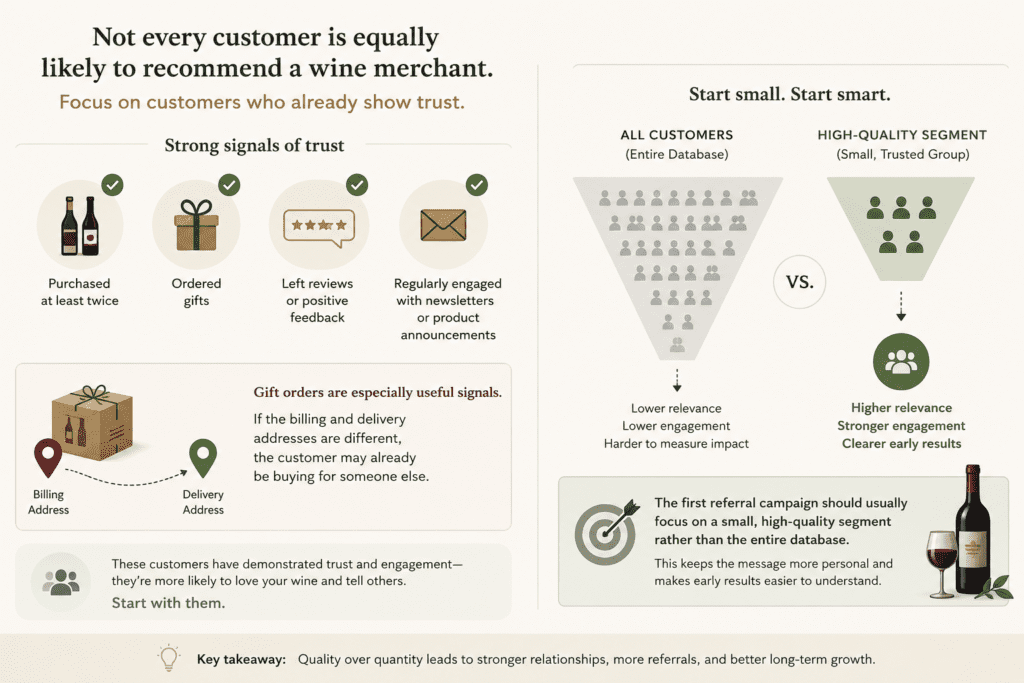
Not every customer is equally likely to recommend a wine merchant. It’s better to start with customers who already show trust: customers who have purchased at least twice, ordered gifts, left reviews or positive feedback, or regularly engaged with newsletters or product announcements.
Gift orders are especially useful signals. If the billing and delivery addresses are different, the customer may already be buying for someone else. The first referral campaign should usually focus on a small, high-quality segment rather than the entire database, which keeps the message more personal and makes early results easier to understand.
Design incentives that fit wine buying
Incentives matter, but they need to feel appropriate. Wine isn’t always a category where aggressive discounting helps the brand. Too much discounting can make a carefully selected portfolio feel cheap or transactional.
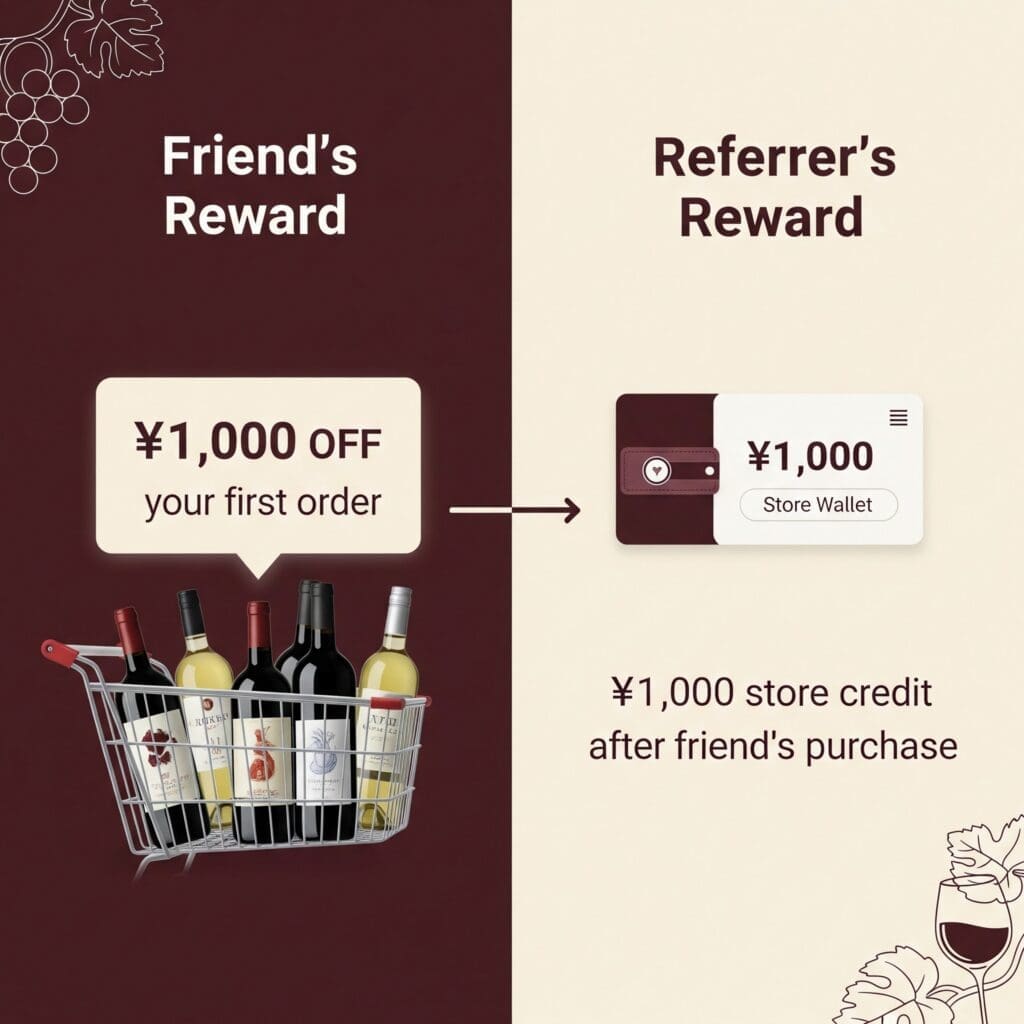
This is simple, understandable, and tied directly to buying behavior. The store credit encourages the existing customer to return, while the first-purchase discount reduces hesitation for the new buyer. Free shipping, a small add-on bottle, limited seasonal items, or early access to selected bundles can also work. The offer should be easy to understand, with a realistic threshold such as ¥1,000 off orders over ¥5,000.
Keep the referral path simple
A referral program only works if customers can use it without thinking too hard. The customer should receive a unique link or code, share it through LINE or email, send the friend to a clear page, and receive the reward automatically after purchase. With approximately 98 million domestic monthly active users as of late March 2025, LINE is particularly well suited to helping customers spread the word.
Mobile usability also matters because many referral clicks will happen from a phone. The landing page should load quickly, explain the offer clearly in Japanese, show relevant wines or categories, and make the next step obvious. Avoid forcing account creation too early, having ambiguous conditions, or using codes that are easy to mistype.
Ask at the right moment
Timing matters. The best time to ask is when the customer’s experience is still fresh and positive, such as after delivery confirmation, a repeat purchase, a positive review, or a successful gifting order.
Asking immediately after checkout is usually too early because the customer has paid, but hasn’t yet received the wine, so a post-delivery email is usually a better fit. A simple message like “If you enjoyed this wine, you can share ¥1,000 off with a friend” feels more connected to the experience without pushing too hard.
Make trust and conditions very clear
Referral programs rely on trust. If the rules aren’t clear, customers hesitate. If rewards are delayed or handled inconsistently, the program can damage confidence instead of building it.
The offer should clearly explain when the reward is granted, whether there is a minimum order amount, whether the reward expires, whether it applies to sale items, and how the customer will receive it. For example: “Your friend receives ¥1,000 off their first order of ¥5,000 or more. You receive ¥1,000 store credit after their order is completed. Credit is valid for 90 days.”
Operational reliability matters just as much as the copy, so if the store says that the reward will be issued after purchase, then that is what needs to happen.
Promote the program consistently, but quietly
A referral program can’t sit hidden in an account page and be expected to grow. Customers need reminding, but the tone should stay helpful rather than loud. The message should focus on sharing a good wine, introducing a friend to a trusted shop, or making gifting easier.
Useful placements include:
- post-delivery emails
- order confirmation follow-ups
- newsletter footers
- packaging inserts with a QR code
- account pages
- small banners on relevant product or collection pages
Gift seasons are also useful moments to promote the program. Ochugen, oseibo, birthdays, Mother’s Day, Father’s Day, and year-end gatherings give merchants natural occasions to frame referrals around generosity rather than discounts.
Track what matters and improve slowly
Once the program is live, the goal is steady learning, not constant change. Track shares, referred visits, referred orders, reward cost, repeat orders, and revenue from referred customers. Compare these results with paid acquisition where possible.
If participation is low, then the issue may be timing or visibility. If people click but don’t purchase, the landing page, incentive, or product selection may need work. If referred buyers don’t return, the second-purchase communication may need attention. Change one main variable at a time, so it is clear what actually improved performance.
Add seasonal and wine-specific improvements
After the basic program works, wine merchants can build on it with simple enhancements. A year-end referral campaign can focus on gifts, dinner wines, sparkling sets, or premium mixed cases. A summer campaign can highlight chilled whites, rosé, sparkling wine, and ochugen-friendly sets.
Referral landing pages can also be improved with curated product sections. Instead of sending every referred customer to the homepage, the link can lead to best sellers, gift-ready wines, beginner-friendly sets, or staff recommendations. The important point is to keep the experience clean. Wine is already complex enough, so the referral flow should make buying easier.
Common mistakes to avoid
The most common mistake is making the mechanics too complicated. If customers have to understand multiple reward levels, unusual timing rules, or unclear exclusions, many will ignore the program.
Other common problems include incentives that do not match wine buying behavior, poor mobile usability, weak promotion, and slow reward handling. A single launch email is rarely enough, and missing credits can quickly damage customer trust.
A practical wine ecommerce example
A customer buys a ¥6,000 mixed set as a birthday gift. After delivery, the buyer receives a short email: “If you’d like to share this wine shop with a friend, you can give them ¥1,000 off their first order.”
The customer shares the referral link through LINE. The friend lands on a mobile-friendly page with a clear offer and a small selection of gift-ready wines, best sellers, and beginner-friendly sets.
The friend receives ¥1,000 off their first order. After that order is completed, the original customer receives ¥1,000 in store credit for a future purchase. That flow works because it is simple, timely, and aligned with how wine is already shared.
Referral programs are a practical growth channel
A referral program won’t replace strong product pages, good email communication, reliable fulfillment, or a well-structured ecommerce site. It depends on all of those things. But when the customer experience is already strong, referrals can become a low-cost growth channel hiding in plain sight.
So to recap: The best place to start is small. Choose a strong customer segment, create a clear double-sided offer, build a simple mobile-friendly landing page, promote it at the right moments, and track the results. For wine businesses selling online in Japan, a good referral program should feel like a natural extension of what customers already do when they find a bottle worth sharing.
About Wine Kiosk
Wine Kiosk makes it easy for wineries, importers, distributors, and wine merchants in Japan to launch a practical, bilingual ecommerce website designed around the realities of selling wine online. For wine merchants that want clearer product pages, stronger customer communication, and a smoother path from discovery to purchase, Wine Kiosk offers a purpose-built foundation for growing direct sales. Anyone interested in seeing how Wine Kiosk can support their online wine sales, product presentation, and customer communication are welcome to contact Wine Kiosk or request a product demonstration.